
Maverick used the auction house to get rich in World of Warcraft. He intends to make ample use of Path of Exile’s Currency Exchange as well, though maybe not so much in 3.25.
Table of Contents
Is the Currency Exchange a Permanent Feature?
Currently, the Currency Exchange is a feature specific to 3.25, Settlers of Kalguur. This means it will not be available in the Standard Leagues.
It is extremely likely that it will go core at the end of the league. Game Director Mark Roberts has acknowledged that they know the backlash would be significant if they were to take it away. He also said that it would be easy to enable it for the core game.
The reason it’s currently a league-only feature is to allow tweaks and, in the worst case, an out if the system ends up having significant issues. In that case it may disappear the next league, to then make its return the league after.
Once Grinding Gear Games announces the Currency Exchange will go core, likely at the end of 3.25, it will become a permanent feature that is also available in the Standard Leagues.
How to Access the Currency Exchange
You µopen the Currency Exchange interface through Faustus. You can access him when visiting Kingsmarch. There will be an NPC from Kalguur (Johan) who can take you there as early as Lioneye’s Watch. Faustus is hanging around the Tavern, which is available from the start.
Once the Currency Exchange goes core, assuming Settlers of Kalguur does not go core right away, it’s likely you’ll only get access to it in Act 6. This is when you unlock the Rogue Harbour (after finding a Rogue Marker and talking to Kurai in Lioneye’s Watch). This is where Faustus hangs out when he is not in Kingsmarch.
You can invite Faustus to your Hideout when visiting Kingsmarch. After that, you will be able to access the Currency Exchange directly from there.
The Basics of the Path of Exile Currency Exchange
Mark’s video above shows the basics in just a few minutes, but the very short summary is this:
- Open the Currency Exchange by talking to Faustus.
- Select the item you want.
- Select the item you offer in exchange. The most common items traded for the one you want are shown at the top of the interface.
- The system will suggest a ratio. This is the best ratio currently available for your trade. If you proceed with this ratio, at least part of your trade will happen right away. You can choose a better ratio, but there is no guarantee your trade will happen quickly or even at all. Note that if you accept the suggested ratio, you will need to click the suggested number in both the “I have” and “I want” windows before you can confirm your trade.
- Confirm the trade. You will need to pay a cost in gold. The more items you want and the more valuable those items are, the higher the gold cost. Note that the Gold needs to be in your inventory. Gold in Kingsmarch’s treasury cannot be used in the exchange. You can talk to Johan and select “Manage Town” to extract Gold from the Treasury back to your inventory.
Handy Commands
There are a few commands you can use to improve your experience with the Currency Exchange that are not so obvious at first sight:
- You can press i to open your inventory while you have the Currency Exchange open (or before you open the Currency Exchange).
- Ctrl-clicking an item in your inventory with the Currency Exchange interface open will put the item directly in the “I have” field.
- Ctrl-clicking an item in the “I have” or “I want” field will swap both items.
- Hovering over the ratio will show the available trades at the moment and their stock. Note that these stocks represent the items you want, so if you are trying to sell something for chaos orbs it will show the amount of chaos orbs they are willing to trade away at that ratio, not how many items they want to buy.
- Pressing alt over the current ratio will show the competing trades. That means checking the ratios of people who want to do the same trade as you. E.g., if you are trying to sell scarabs for chaos, it will show other people doing the same and the ratios they are offering. It is often a good idea to price your items slightly better than this ratio rather than at the current available ratio. For commonly traded items your trade will fulfill by the time you finish pricing your other trades or run a lap around your hideout
- Ctrl-clicking an item after a completed trade will move a stack into your inventory. Ctrl-right clicking will move all stacks into your inventory (providing you have room). These shortcuts also work when trading with players using the classic system or moving items from and to your stash.
Why Didn’t My Trade Order Get Fully Fulfilled?
This happens when someone buys a portion of your order and it is impossible to fulfill the rest of it.
You can avoid this by using rounded ratios.
When a trade is unfulfilled, you will get the untraded resources back, as well as a portion of the gold (depending on the portion of the trade that was unfulfilled).
Gold in Path of Exile
Gold is a new currency that only drops in the Settlers of Kalguur League, not in Standard Leagues. Most monsters that drop equipment have a chance to drop Gold (the exception seems to be Sanctuary), though not all content drops as much. . Once the Currency Exchange goes core, Gold will also drop in Standard. The further you get into the game, the larger the Gold stacks that will drop.
Whenever you place an Order in the Currency Exchange, you will need to pay a Gold cost.
You cannot trade Gold with other players. You can only get it by actively playing the game.
Currency Exchange Gold Costs
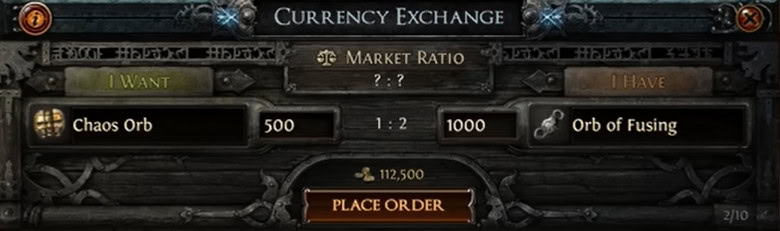
The more items you put an order for from the Currency Exchange, the more gold you will pay. Items that are individually more valuable will also cost more (in general, not always, e.g. placing an order for Orbs of Fusings costs more than placing an order for Chaos Orbs). Gold makes it harder for bots, hideout warriors/currency flippers and price manipulators to have a large effect on the market.
Below are some examples of Gold costs you need to pay to place an order. Remember that you don’t buy Orbs directly with Gold. You also need to put up currency of your own (e.g., Chaos Orbs) up for exchange at a ratio other players are willing to part with the currency you want:
- Orb of Transmutation: 5 Gold cost per Orb
- Chaos Orb, Orb of Alteration: 25 Gold
- Orbs of Fusing: 40 Gold
- Divine Orb: 250 Gold
- Mirror of Kalandra: 25,000 Gold
- High-tier Essences: 75 Gold
- Scarabs: 75-350 Gold, depending on rarity
- Divination Cards: 15-1850 Gold, depending on rarity
- Lifeforce: 0.25 per unit (which can add up quite quickly!)
What You Can Trade for in the Currency Exchange
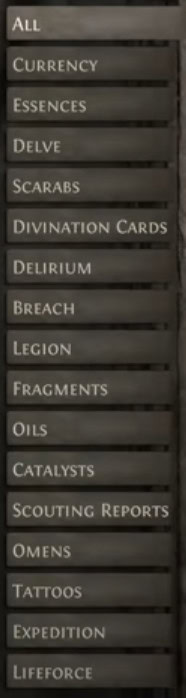 You may have noticed I talked about Divination Cards earlier. The Currency Exchange counts just about everything that can be stacked as currency, not just what is in the Currency Tab. That means you can trade:
- Items in your Currency tab (duh)
- Essences
- Fossils
- Resonators
- Scarabs
- Runes (3.25-specific currency)
- Divination Cards
- Delirium Orbs
- Simulacrums
- Blessings and Breachstones
- Legion Emblems
- Fragments (Atziri, Shaper, Elder, Elderslayers, Maven, Uber, Ritual)
- Oils
- Catalysts
- Scouting Reports
- Omens
- Tattoos
- Expedition Reroll Currency
- Lifeforce
What You Cannot Trade for in the Currency Exchange
- Gold
- Equipment (including Jewels and Flasks)
- Maps (including Invitations, Memories, Logbooks)
- Gems
- Beasts
- Temples
- Incubators (they can technically stack, but only if the ilvl is the same, I guess it would be too convoluted. If you don’t care about the kind of Incubator and the price is good, you can put an order in for the Parasitic Passengers Divination Card. 8 of those give 10 random Incubators)
- Contracts and Blueprints (3 “Something Dark” Cards give a fully revealed Blueprint, though)
- Forbidden Tomes that give access to the Forbidden Sanctum.
You can still get these through the Traditional Trading system.
The Costs of Using the Currency Exchange
Earlier we gave some examples of Gold Costs for putting items up for trade. This ranged from 5 Gold per Orb of Transmutation to 25,000 Gold for a Mirror. That doesn’t tell you much, however, if you don’t know how common Gold is.
According to Grinding Gear Games, Gold costs are balanced around the midgame. It is difficult to “entirely unreasonable” to use in early game and should be “fairly trivial” at end game. After playing around with it a bit, that’s a fair assessment, but it assumes:
- Your Kingsmarch workers, the recombinator and Faustus’ Black market are not eating the vast majority of your Gold income.
- You are mapping regularly instead of doing side content, preferably at higher tiers. Side content such as Blight Maps and Simulacrums don’t give a lot of Gold, The Forbidden Sanctum gives none.
- Most of your Orders are to sell the loot you find and to buy items you need. You are not heavily flipping items or doing large crafting projects.
- You don’t need large amounts of unreasonably priced currency items, such as Chromatic Orbs, Jeweller’s Orbs (25 Gold, same cost as Chaos Orbs) or Orbs of Fusing (40 Gold, more than Chaos Orbs)!
- You have already completed the Challenge which requires you to have 250,000 Gold in your Kingsmarch coffers and have already completed all upgrades in Kingsmarch (or you are not interested in doing so).
If some of these assumptions do not apply to you and you are not doing Tier 17s (which drop a lot of gold) to compensate, you may want to be careful on how you spend your Gold.
Tip for Saving Gold
1. Focus on Quality of Life

The traditional trading site remains. When trading for non-stackable items, equipment or when playing on Standard, it will be the only way to trade. On top of this, however, it will also remain functional for items you can trade in the Currency Exchange.
Remember also that:
- You will be able to use the Currency Exchange to check the current ratios for the trade you are trying to do. Simply enter the items you want to buy and which items you want to give in exchange but then don’t confirm the trade. This will give you an idea on the current going rate and avoid price fixers with listings they are not actually willing to sell.
- It is now possible to shift-right click a currency to move as many as would fit your inventory from not just the Currency Exchange but also your Stash. You can also put items in your Stash in the same way. This will make the traditional trading system more convenient as well.
With this in mind, if you’re not swimming in Gold, you will still want to use the Traditional system for expensive, quick trades (e.g., buying or selling a big stack of Lifeforce) or for items that have a high Gold cost if you need many of them (Chromatic Orbs, Orbs of Fusing, Jeweller’s Orbs). On the other hand, even if you would rather use your Gold on other things, you may still want to use the Currency Exchange for smaller, frustrating trades (e.g., Instilling and Enkindling Orbs, Catalysts).
For selling full tabs at once (e.g., all of your Fossils if you’re delving a lot), you may also want to consider using a service such as the “The Forbidden Trove” (TFT) Discord Server.
2. Price your items reasonably
If you don’t have Gold to spare, you will want to make sure you choose a ratio that will actually fulfill your order. Remember, cancelling your trade does not refund the Gold cost, so is effectively flushing Gold down the drain. You don’t necessarily need to price your items at the current going rate, but you will want to at least offer a better rate than the best competing trade.
3. Trading for Divine Orbs is cheaper
A Divine Orb only costs 250 Gold. This is the equivalent of 10 Chaos Orbs, while Divine Orbs are always worth well over 100 Chaos Orbs. That means trading for Divine Orbs is cheaper than trading for Chaos Orbs.
If you are dealing with items which you are often gathering (e.g., Lifeforce if you’re specced into Harvest), you may want to wait until you have enough Lifeforce to trade directly for Divine Orbs.
If you have a good portion of a Divine and don’t foresee getting the rest anytime soon, you may want to buy some extra. E.g., if I have 0.8 Divine Orbs worth of Lifeforce, I may trade some of my Chaos Orbs for more Lifeforce so I can sell all of my for a Divine. Since Lifeforce doesn’t cost a lot of Gold and is traded frequently, it will be a cheap and fast transaction.
On the other hand, consider putting up items you wouldn’t have bothered with in previous Leagues. E.g., if a Sentinel (they can spawn randomly in T16s and T17s this League) gives you some Expedition currency and you’re not specced into Expedition, just put it up for sale. Earning 5 Chaos here and there adds up quickly if you can get it instantly without having to go through the traditional trading process.
4. Don’t go overboard with your workers
Level 2 workers work about 50% faster than Level 1 workers, but cost 100% more. That means you can get 3 Level 1 workers for the same speed as 2 Level 2 workers, but they will cost you 25% less in total. The same is true when comparing Level 2 and 3.
Timers keep going while you’re offline. If you’re a casual player who isn’t that far along yet in your progress, Level 1 workers can be enough at the start for mining, smelting and farming. For shipping and disenchanting this tip is less advisable, unless your shipments can keep up with your excess stock (mine could not). More and higher-level workers allow you to send larger shipments.
As you get further into the game, you’ll have to upgrade workers to keep up with what you’re gathering, regardless of their lower cost efficiency. At that point all levels from 2 up to 9 are about the same efficiency, with a small drop in efficiency for Level 10. Simply hire the workers you need to get the job done at that point, but remember that you’re not forced to have a full army of Level 10 Farmers to still send shipments regularly.
Also, make sure you don’t assign unqualified workers (e.g., a worker with Farming level 3 to Smelting). They will be even less efficient than a Level 1 worker but still charge their higher level wage! Also be careful of workers with multiple skills, as their Gold cost will reflect their most expensive job.