
Maverick decided to write a shorter article concentrating specifically on competing trades because this is the number one question he sees about the Currency Exchange.
What Competing Trades Are

Competing trades are trade orders by people doing the same thing as you are. For example, if you are trying to buy Scarabs for Chaos Orbs, it shows other people also wanting to buy the same Scarab for Chaos Orbs. These trades are mainly interesting for getting a better price for your items, as we’ll discuss further below.
In the screenshot above, we see that if we want to buy 10 Cartography Scarabs of Corruption immediately, we would pay 139 Chaos. By looking at the competing trades, we see that the closest price someone is willing to pay is 13 chaos per Scarab. We also see that he only has 27 Chaos orbs in stock, so his order will be fulfilled soon. That means that if we offer 118 Chaos Orbs, we’ll soon have the best offer available to those willing to sell this type of Scarab.
Many people want immediate sales trades Path of Exile’s Currency Exchange has a lot of activity. That means orders complete fast using this strategy, especially items used by (almost) the entire player base, like Scarabs. After a single map, orders using this pricing method will usually already be completed. Often, your Chaos will even already be waiting for you after you run a lap around your hideout.
Using this strategy, you can spend less currency buying and earn more currency selling. In the example above, you would only pay 118 Chaos instead of 139 Chaos. As said before, it also wouldn’t take much time at all to do so.
For a more complete overview of pricing your items in the Currency Exchange, check out this article.
Market Ratios vs. Competing Trades
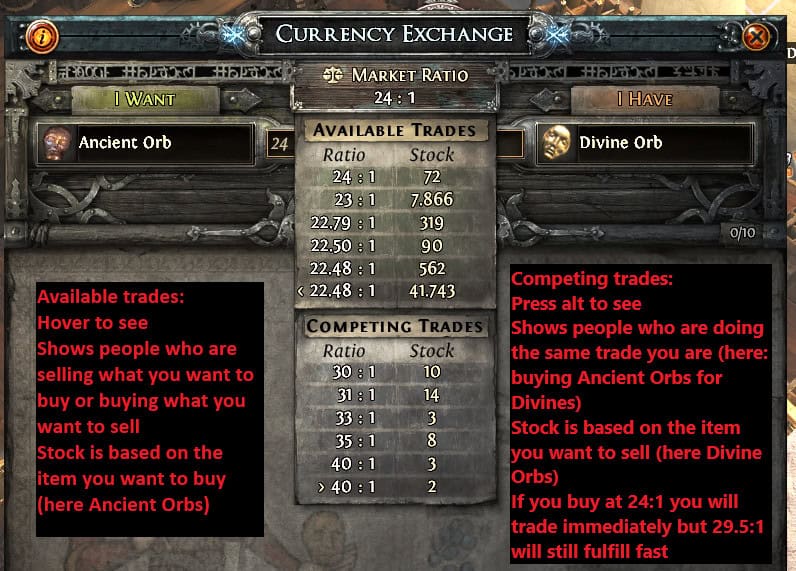
In the above screenshot, you can see a recap of the differences between Market Ratios and Competing Trades.
The main thing to pay attention to are what “Stock” means in both, as the difference is not so straightforward:
When buying items for Chaos/Divines, market ratios show the amount of items sellers have in stock. Competing Trades, however, show the Chaos/Divine stock of those wanting to buy the same items as you. If you’re buying items for Chaos Orbs, that means competing trades generally fulfill faster than you would expect (as each sale tends to make the stock go down by multiple units). If you’re buying for Divine Orbs, they fulfill more slowly (as your competitor can tend to get a bunch of items for 1 unit of stock).
When selling items for Chaos/Divines, market ratios show the amount of Chaos/Divine items competing sellers have in stock. Competing Trades show the number of items those wanting to sell the same items as you have in stock. This generally makes for easier estimations on how fast these orders will be fulfilled than when you’re buying items.